A Late-Autumn Walk That Follows the Light
A late-autumn walk that follows the light offers a simple way to enjoy shifting skies, bare branches and familiar streets before dusk settles in.
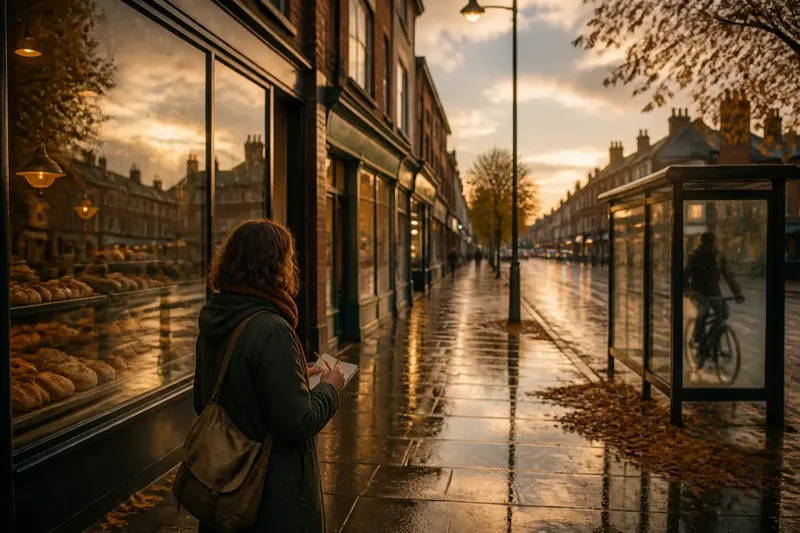
The common mistake on a late-autumn walk is choosing a destination first and treating the changing light as background. The cost is missing what is already close by: a copper-coloured shop window, a wet pavement reflecting the sky, or the brief glow on a row of upstairs rooms. A late-autumn walk that follows the light can begin at the nearest familiar street, with no scenic landmark required.
Imagine that Rowan steps out after lunch on a grey-bright afternoon, carrying a small notebook and a pencil. Rather than setting a route around a park or stream, Rowan notices how the town’s ordinary surfaces change: brick, glass, wet paving and the pale strip of sky between roofs. The notebook is there to catch one detail worth remembering, not to turn the walk into a catalogue.
Look for light on ordinary surfaces
Late-autumn light often works by contrast. A lit window can stand out against a dark façade; a shallow puddle can hold a patch of cloud; the smooth side of a bus shelter can briefly reflect the street behind it. These details need no special destination. They appear along routes already used for errands, school runs and the walk to the corner shop.
Glass and water are especially changeable. A shop window may show the street more clearly than the display inside, while a puddle can catch a bright shape until a passing shoe breaks it apart. Painted railings, glazed tiles and polished door handles can also take on a different look when the sky brightens between clouds.
Choose a street with a few different surfaces and take the ordinary pavement.
Notice how shopfronts and windows borrow the sky
Rowan walks past a bakery, a bus stop and a row of terraced houses. The bakery glass reflects the opposite pavement; farther along, the dark windows of a closed shop hold a strip of cloud. At the bus stop, the shelter’s side panel catches a passing cyclist as a blurred shape. The scenes are fleeting, and that is part of their appeal. There is no need to wait for the reflection to return in exactly the same form.
It helps to look from more than one angle, while staying on the pavement and away from entrances. A reflection can disappear when you move a few steps, or resolve into the object behind the glass. Neither result is a failure. The change is the subject.
On a busy street, keep your attention and your belongings in their usual sensible places. Glancing at a window is not a reason to stop where people need to pass.
Let weather alter the view rather than the plan
Cloud, drizzle and a dry spell all give familiar streets different surfaces. After rain, paving stones can reflect a brighter sky; in a dry, overcast spell, the same street may look more even, with colour showing in painted doors and shop signs. Wind can lift loose leaves into a gutter or scatter them across a square. None of this needs to become a forecast to manage.
Say Rowan has a free afternoon, a notebook, and a familiar route past the market and the library. At the market, the pavement is wet and the shop glass reflects the opposite stall fronts, so Rowan writes down “red awning in the pavement” and carries on. By the library, the rain has stopped, the pavement no longer reflects as clearly, and the windows show more of the clouded sky; Rowan adds that change and heads home by the lit main street. The resulting note preserves two different views from one ordinary outing, without requiring a detour or a wait for the weather to perform.
If rain makes a surface slippery or the light too poor to see comfortably, take the familiar, well-lit route home. A reflection is not worth an awkward landing.
Keep a small record without turning it into homework
A note can be as short as “blue door, grey sky” or “lamps in wet glass”. If you prefer photographs, take one from a safe, unobstructed place and leave passers-by out of frame where possible. The point is to remember a quality of the afternoon, not to produce a polished set of images.
- Check whether the pavement is wet; if reflections are visible, look for a safe place to pause, but if it is slick, keep walking on the clearer side of the street.
- Check whether a shop window reflects the opposite buildings; if it does, note the colour or shape, but if the display is clearer, look at how its lighting meets the grey daylight.
- Check whether the sky appears in a bus shelter panel; if it does, observe how the view shifts as you pass, but if the panel is busy or obstructed, continue without stopping.
- Check whether streetlamps are visible against the afternoon sky; if they are, notice the contrast with nearby windows, but if visibility is fading, choose the brighter main road home.
- Check whether loose leaves are gathering along the kerb; if they form a visible pattern, record its colour or direction, but if they cover the walking surface, avoid the patch and use clear paving.
- Check whether a useful detail is easy to remember; if it is, write a few words or take a safe photograph, but if nothing holds your attention, leave the notebook closed and enjoy the walk as it is.
What do people notice on a late-autumn walk?
What is worth looking for on a familiar street?
Look at how the sky appears in windows, how wet paving catches colour, and how bare branches frame gaps between buildings. A small change in reflection can be more interesting than a distant view.
Are overcast afternoons worth walking in?
Yes, if the weather is comfortable and the route is safe to walk. Soft light can make colours and reflections easier to notice, though persistent rain may be a good reason to shorten the outing.
Should I take photographs or make notes?
Either is enough, and neither is necessary. A brief note may preserve a detail without interrupting the walk; a photograph can help when the shape or colour matters more than a description.
How can I make the walk comfortable as daylight fades?
Use familiar pavements, keep a well-lit way home in mind, and wear a layer suited to the weather. If the route becomes hard to see or unpleasant underfoot, head back rather than extending the outing for a better view.
Leave room for the detail you did not expect
Rowan’s notebook ends with a brief entry about a pale sky reflected in the library’s dark windows. It was not the most dramatic sight on the route, but it changed as Rowan crossed the street: first a clear band above the rooftops, then a faint patch between shelves and curtains. The note is enough to bring that shift back later.
A late-autumn walk that follows the light can be built from shop glass, wet paving and whatever the weather leaves visible. Keep the route familiar enough to enjoy without planning each turn, and use the notebook only when a detail deserves keeping. The most useful reminder may be to look at the windows on the way home; they often hold a different sky from the one you left behind.